The initiative to develop research on renewable and biodegradable material sources is crucial for preserving a more sustainable environment.
This research is particularly significant as the world faces the threats of plastic and polystyrene impacts. Toxic results from these materials endanger life and contribute to ozone depletion.
In Malaysia specifically, the Solid Waste Management and Public Cleaning Corporation (SWCorp) reports that approximately 37,800 tons of waste are disposed of daily, with at least 1.17 kilograms (kg) of waste produced per person.
Among this, paper waste accounts for the largest share at 17 percent. Plastic is the second-largest waste, making up nine percent. Although it is second, plastic waste is a major concern.
Plastic and polystyrene take 500 years to decompose! Their non-biodegradable nature and uncontrolled disposal raise significant concerns.
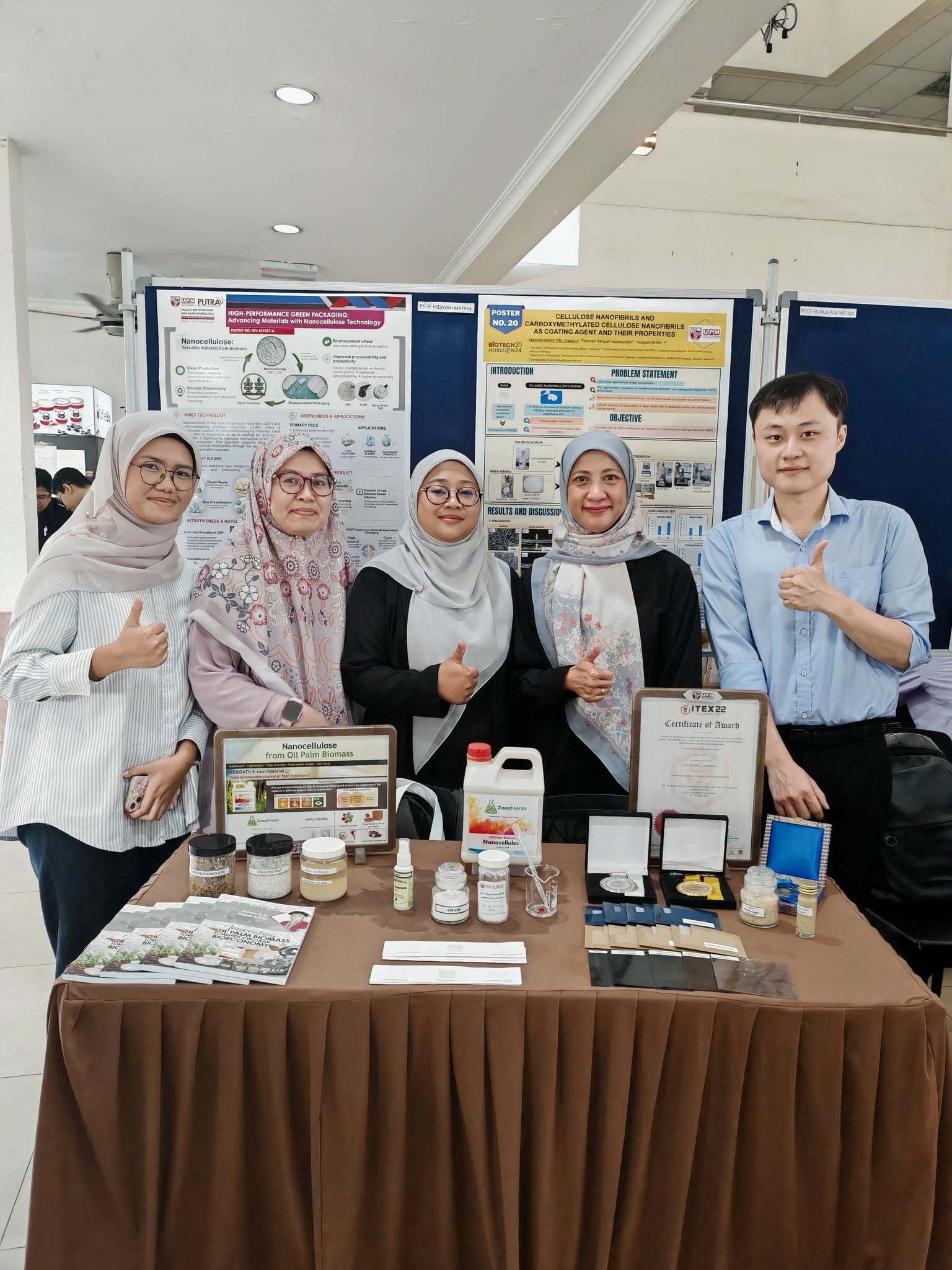
Concerned by this issue, a group of researchers from Universiti Putra Malaysia (UPM) led by Associate Professor Dr. Hidayah Ariffin, along with Professor Datuk Dr. Mohd Ali Hassan, Liana Noor Megashah, Dr. Mohd Nor Faiz Norrrahim, and Dr. Tengku Arisyah Tengku Yasim Anuar, have pioneered research on palm biomass nanosellulose, identified as an environmentally friendly agent.
Started in 2013 and continuing to the present, this research has received grant funding from the Malaysian Ministry of Education, UPM, and the Science and Technology Research Partnership for Sustainable Development (SATREPS), Japan.
Interestingly, the new feature related to palm biomass has also received collaboration from the Kyushu Institute of Technology, Japan, which is a source of national pride.
Whereas palm waste was previously overlooked and often discarded by burning, this practice is no longer prevalent in some areas.
Dr. Hidayah, who is also the Deputy Director of the Tropical Forestry and Forest Products Institute (INTROP) at UPM, explains that nanosellulose produced from palm mesocarp, empty fruit bunches, and palm fronds has its 'magic.'
"All these materials are rich in cellulose. Nanosellulose is cellulose with a diameter size under 100 nanometers (nm) and possesses special properties.
"Our research shows that nanosellulose has strong characteristics. It has high clarity, a large surface area, and is extracted from renewable and biodegradable sources," she says.
Further elaborating, these special properties make nanosellulose highly suitable for various industries, including eco-friendly food packaging plastics.
Nanosellulose can be used as an additive in plastic products, composites, food, cosmetics, and pharmaceuticals to enhance product features, says Dr. Hidayah.
"Thus, this new feature can replace existing chemicals used to improve the quality of materials," she told e-Trend recently.
Nanosellulose, used as an additive due to its excellent strength properties, can be incorporated into any commercial industrial product.
Dr. Hidayah explains that its function can improve various aspects of the material, including mechanical strength, viscosity, thermal properties, and crystallinity.
Commercial Value
"For example, based on current findings, adding one percent nanosellulose to polypropylene (a thermoplastic polymer) increases mechanical strength by 33 percent compared to pure polypropylene.
"Meanwhile, adding three percent nanosellulose to polyethylene (a thermoplastic commodity) also shows an increase in flexural strength by nearly 200 percent," she adds.
Regarding the production method, Dr. Hidayah says that nanosellulose is produced from cellulose using high-tech mechanical processing methods.
Through this technology, nanosellulose from palm biomass pulp can be produced quickly, easily, and without chemical use.
"The nanosellulose size obtained from this method ranges from 10 to 50 nanometers (nm), comparable to nanosellulose from other existing methods," she explains.
Asked about the main factors for choosing this natural source, the lead researcher explains that nanosellulose has been listed in the 11th Malaysia Plan under strategic research.
The commercialization of this material is believed to enhance the country's economy in various aspects such as plastic production, packaging, composites, food, cosmetics, and health fields.
"We believe the use of raw materials from waste will add value to palm oil, and the latest technology developed allows more materials to be processed simultaneously," she says.
Adding to the excitement about the potential of nanosellulose, Dr. Hidayah explains that this new product can be used in several other applications, including vehicle parts manufacturing, paper processing, paint, coatings, and related research.
It is fitting that the target users of this innovation include plastic manufacturing companies, construction, paper industries, paint industries, healthcare, pharmaceutical products, aerogels, and higher education researchers.
Click here for more information: https://www.sinarharian.com.my/article/66152/turbo/nanoselulosa